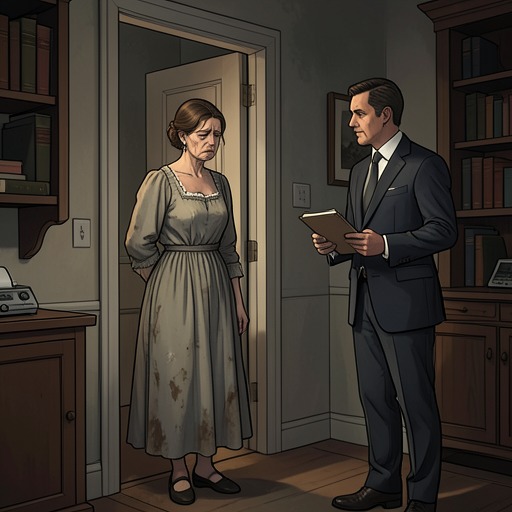
Mary Drower
The A.B.C. MurdersMary Drower is Alice Ascher’s niece, a parlourmaid, and one of the people who refuses to remain a passive witness to the A.B.C. murders. Her grief for the aunt who raised and supported her becomes a reason to help investigate, while her practical suggestions and presence at Doncaster draw her into the case’s unfolding pattern of threatened alphabetical victims.
Identity and Background
When Hercule Poirot and Arthur Hastings visit the house where Mary is working, she answers the door with red eyes after recent weeping. Poirot recognizes her as the parlourmaid he has come to question. Her grief is rooted in a close family bond: after her mother died, Mary went to live with her aunt in London at the age of eleven. She later entered service at sixteen, but ordinarily spent her days off visiting Alice.
Mary remembers Alice as consistently kind to her. She also knows about the difficult history of her aunt’s marriage: Alice had spoken of her estranged husband as her “old devil,” and Mary describes him as someone who would not leave her in peace. Her account supplies Poirot with a family perspective on Alice’s life, distinct from the evidence gathered at the crime scene.
Mary is the only close relative Alice has left. Alice was one of ten children, but only three survived to adulthood. Mary’s mother had died, an uncle had been killed in the war, and another uncle had gone to South America and disappeared from the family’s knowledge. Mary’s relationship with Alice is therefore not merely one of affection; it is the last surviving connection in a diminished family circle.
From Bereavement to Participation
Mary’s involvement develops beyond answering police questions. After the first murders, she writes to Poirot proposing that people affected by the crimes should work together. She has seen a newspaper photograph of Megan Barnard, sister of the Bexhill victim, and writes to Megan to offer practical solidarity. Megan replies that she works in an office and lives in a hostel, and suggests that Mary contact Poirot instead.
In her letter, Mary explains that she is coming to London to find a place and believes that two people who know something about the murders may be better able to discover the killer. She offers to work for little pay, making clear that her purpose is not simply employment but participation in the search. Poirot judges her intelligent, and her initiative confirms that the bereaved young woman has turned toward action rather than withdrawal.
Poirot gives Mary a concrete investigative task in Andover, where Alice was killed. Since she is known in the street where her aunt’s shop stood, he asks her to approach the local children and see whether they noticed anyone entering or leaving. His reasoning is that children may speak more readily to someone familiar than to outsiders. The assignment uses Mary’s personal ties to the neighborhood as an investigative advantage.
At Doncaster
Mary later joins the group gathered as the investigation turns toward Doncaster. When Donald Fraser urges the others not to give up, Mary adds her own encouragement: the killer is in the same place as the people seeking him, and chance encounters can bring people together in unexpected ways. Her remark is hopeful but grounded in the immediate circumstances; she believes the search still has a chance because both pursuers and quarry are present in the town.
The group plans to cover as much ground as possible, patrolling streets in the morning and later taking positions around the racecourse. Arthur Hastings expects to escort one of the women. Poirot redirects him specifically to Mary and insists that he must not leave her. The reason is the alphabetical pattern: Mary’s name begins with D, the same initial as Doncaster, the next location associated with the predicted murder. The escort is therefore a precaution arising from the case’s structure, not a casual social arrangement.
Mary’s place in the investigation gives the alphabetical scheme an immediate human dimension. The pattern does not remain an abstract sequence of locations and victims; it shapes who may be exposed to danger and how the investigators distribute their protection. Poirot’s instruction makes Mary’s own name part of the risk calculation.
Narrative Role and Significance
Mary links the first crime in Andover to the later investigation through memory, family connection, and voluntary action. She can speak about Alice as a niece who visited her regularly, help investigators think about witnesses in the neighborhood, and recognize the value of joining forces with Megan Barnard. These contributions make her more than a source of background information: she becomes a participant in the response to the killings.
Her role also contrasts with the killer’s attempt to turn the murders into a sequence governed by initials. The alphabetical logic threatens people by converting names and places into a pattern; Mary meets that logic with personal loyalty and collective effort. At Doncaster, the same pattern that makes her vulnerable prompts Poirot to protect her, while her earlier proposal to cooperate with Megan shows how the murders bring survivors into contact with one another. Mary’s arc thus moves from the bereaved relative at Alice’s door to an active, protected member of the search.